How animation works
Animation is the illusion of motion
and change. It is done by viewing a lot of written images in quick succession.
The effect given from viewing the images quickly makes it look like the image
is moving. The lowest frames per seconds for the illusion to work is 10 fps. It
is due to something that happens between the eye and the brain.
Zoetrope
The Zoetrope
was one of the earliest animation devices that was developed. The device
consists of two things, a cylinder with vertical slits and a paper band with
images on it. The band is put inside the cylinder and it is spun around. The
user looks into the slits and sees the images going around at a quick
succession, producing the illusion of movement. The Zoetrope was created by
William Horner. Some of the drawbacks to this device though was it had no sound
to it. When you spun the cylinder and the image appeared to move there was no
background noise. Even though another drawback of it was that it was
repetitive, you would just put another band in and another set of images would
move. The image below displays the Zoetrope with the band and the cylinder that
is used to make the image move.

Phenakistoscope
The developer of this device was Joseph Plateau. He was the first person to show the illusion of the moving image, he introduced the Phenakistoscope in 1832. The Phenakistoscope used a spinning disc attached to a handle. Around the disc's centre are a series of drawings showing each image being included in the animations. The person using it would spin the disc and look through the moving slits at the disc's reflection in a mirror. This would give the illusion of movement. the image below shows the examples of disks that were used.
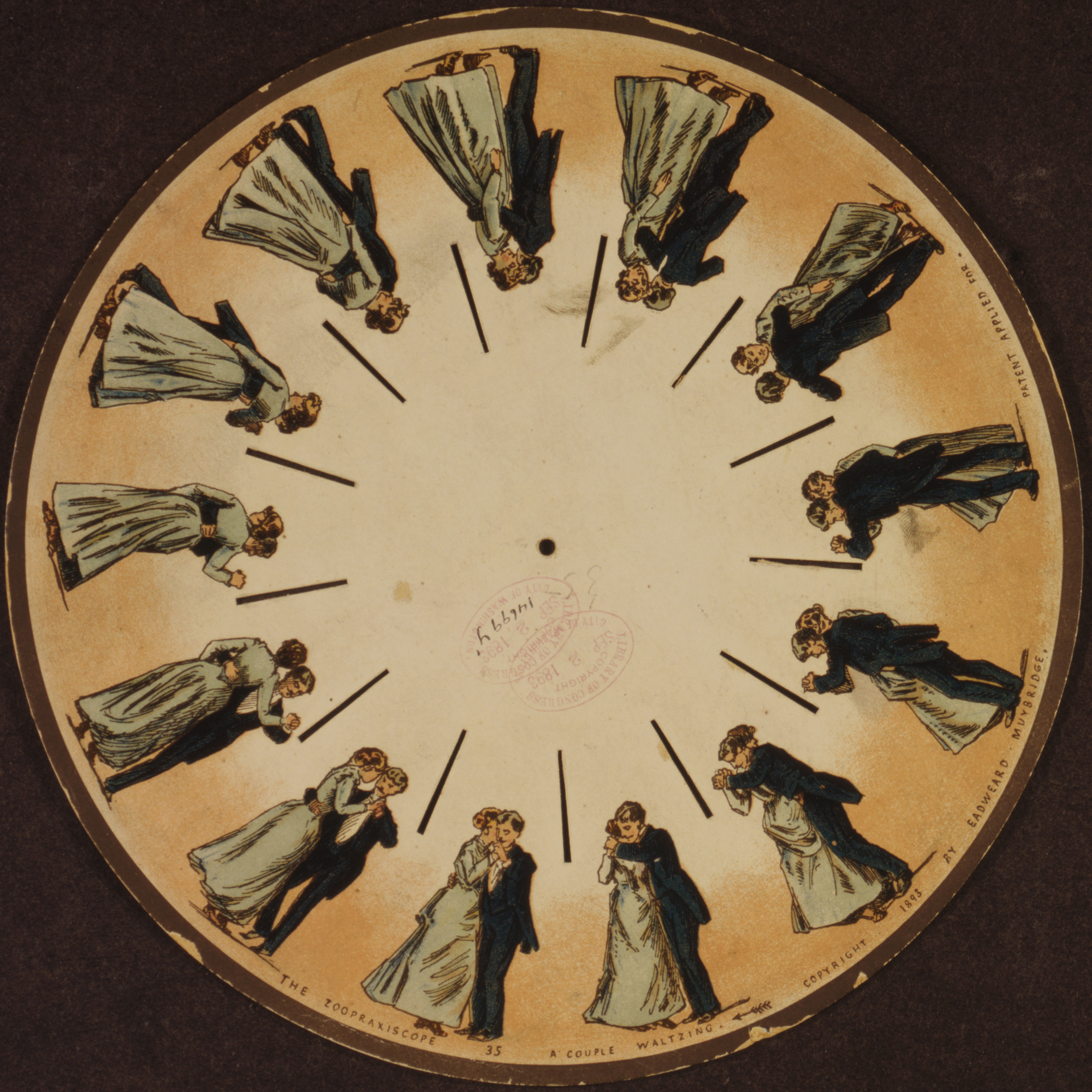

Zoopraxiscope
It is a device
that displays motion picture. The device was created by Eadweard Muybridge in 1879. It is considered to be the first movie
projector. The Zoopraxiscope projected images from rotating glass disks,
at the right rate to show motion. All of the disks that were used on the
disks showed birds, animals and humans. The Zoopraxiscope had a lamp, a lens, and an adjustable shutter just
like a normal projector. The image below displays the Zoopraxiscope.

Thaumatrope
This early animation was a toy that was popular in the 19th century.
There is a disk on each side, with pictures on them,
they are attached together by pieces of string. The string is twirled using
your fingers quickly to see both images. When they are seen quickly together,
it looks like the two images combine together to make one image. This is due to
the persistence of vision. One of the most common use of pictures is the bird
and a bird cage, when they are seen quickly it looks like the bird is in the
cage. This was created by John Ayrton Paris in 1825. An example of a Thaumatrope
is displayed below.

Persistence
of vision
With
animation it is done with a load of images that are viewed in a quick
succession. When viewed they create the illusion of movement. This is linked to
what happens between the eye and the brain which is called the persistence of
vision. The Thaumatrope is an example of an old animation device that supported
the idea of persistence of vision. This theory does not apply to today because
it is an outdated theory. This is because it does not account of the brain and
it discounts it.

Beta
movement
The
beta movement is described as an optical illusion. It is to do with a load of
static images that are able to flow smoothly. This is when the frame rate is
increased, greater than 10 frames per second. The static images do not change,
they give the effect of motion because of them being rapidly changed. This was
first mentioned in 1912 by Max Wertheimer. Beta movement can be considered as important because it
is used in lighting today. But in the case of animation it is not considered as
important.

Suspension of disbelief
The term suspension of disbelief was first used in 1817 by Samuel Taylor Coleridge. It is
where you take something that does not exist and put it in reality and where
the audience believes it. It was believed that it was up to the reader, rather than the writer, to achieve it. It mostly
applies to fictional works of the genres for action, comedy, fantasy, and
horror. For a film example there is Jason and the Argonauts, where there is a
fight between people and skeletons. The audience in this case would believe
that people are fighting impossible beings, which in this case are skeletons.

Frame rate
Frame rate is one of the most
important aspects for animation. The frame rate affects the speed of which the
image is moving, it affect the motion speed. If the frame rate is low then the
outcome of the characters or whatever is being animated will move and act will
be slow. It can be linked back to the persistence of vision, where if a load of
images are viewed quickly; it will give the illusion of movement. Comparing it
to early animations such as Gertie the dinosaur, which did have a low frame
rate and the flow of the animation wasn't smooth. However with an animation
like Toy Story, the frame rate is quite high so the flow of the animation is
very smooth. So frame rate affects how smooth the outcome of the animation is.
Another example can be with Jason and the Argonauts with the skeleton fight
scene, the frame rate was quite low so the skeletons moved quite slow and the
movements jumped from one to another, this also affected the flow of the scene.
Lion king has a higher frame rate; this can be to do with it being produced on
a computer and not produced with the stop motion technique

No comments:
Post a Comment